Moneymaxxing in the USA as a Canadian
Disclaimer: I am not a financial expert. Every case is different for every person, and financial goals differ, so please conduct your own research or consult with a professional.
TL;DR: To maximize your financial position, prioritize in order: 401(k), Roth IRA, Mega Backdoor Roth 401(k), Health Savings Account (HSA), and Individual Account.
For Canadian skilled professionals moving to the United States on a TN visa, the financial landscape shifts dramatically. While the US offers significantly higher tax-sheltered investment room compared to Canada, a temporary stay requires a deliberate cross-border exit strategy to avoid tax penalties and optimize repatriation.
1. US vs. Canadian Limits
The primary advantage of the US tax system lies in its immense contribution thresholds, especially when taking advantage of advanced corporate structures like the Mega Backdoor Roth In-Plan Conversion. Let us look at the visual disparity between annual contribution caps:
| Vehicle Type | United States Equivalent (2026 Limits) | Canadian Equivalent (2026 Limits) |
|---|---|---|
| Pre-Tax / Tax-Deferred | Traditional 401(k): $24,500 (~$34,400 CAD) | RRSP: 18% of earned income up to $32,500 |
| Post-Tax / Tax-Free Growth | Roth IRA: $7500 (~$10,620 CAD) | TFSA: $7,500 |
| Post-Tax / Tax-Free Growth | Mega Backdoor Roth 401(k): Up to $46,500 (~$65,100 CAD) (via after-tax space) | N/A |
| Health & Investment Hybrid | Health Savings Account (HSA): $4,300 (~$6,020 CAD) | N/A |
| Aggregate Annual Shelter | $74,300 (~$104,020 CAD) | ~$39,500 |
2. Traditional 401(k)
When returning to Canada, you will face a crucial cross-road regarding your Traditional 401(k). Under Article XVIII of the Canada-U.S. Tax Treaty, Canada recognizes a Traditional 401(k) as a qualified pension. This means the growth remains fully tax-deferred for both IRS and CRA purposes as long as it remains inside the account.
2.1 Transferring to an RRSP (optional)
It is legally permissible under Canadian Income Tax Act Section 60(j) to transfer a lump-sum distribution from a US 401(k) directly into an RRSP without using up your existing RRSP contribution room. However, executing this creates a massive liquidity squeeze that catches many expats off guard.
When you withdraw your money from a US 401(k) provider to move it to Canada, the US custodian is legally required to withhold a mandatory 30% flat non-resident withholding tax (plus a potential 10% early withdrawal penalty if you are under age 59.5).
For instance, if your 401(k) has accumulated V = $100,000, the US custodian will only wire you $70,000. To avoid a massive Canadian tax bill on the withdrawal, you must find $30,000 of your own cash to deposit a full $100,000 into your RRSP. You will eventually get that money back as a foreign tax credit when you file your Canadian tax return the following April, but you must have the liquidity to float the bridge for months.
2.2 Recommendation
It is strongly recommended to take full advantage of your employer's matching program and maximize your 401(k) contributions, as this serves as the direct US alternative to a Canadian RRSP. Failing to do so effectively results in forfeiting the RRSP contribution room, as this room does not accumulate while you are not a Canadian tax resident.
3. Roth IRA
When returning to Canada, you will face a crucial cross-road regarding your Roth IRA. Unlike the 401(k), which is automatically recognized as a qualified pension, Canada requires you to file a one-time treaty election by April 30th of the year following your return to preserve your Roth IRA's tax-exempt status. Once this election is made, the growth remains tax-free for both IRS and CRA purposes, provided you adhere to the strict rule of never contributing additional funds.
3.1 Backdoor
The Backdoor Roth IRA is a strategy for high-income earners who exceed the income thresholds for direct Roth IRA contributions. It involves making non-deductible contributions to a Traditional IRA and then converting those funds into a Roth IRA. Make sure to file Form 8606 with your tax return to document the non-deductible nature of the contribution.
3.2 Recommendation
It is strongly recommended to prioritize the Roth IRA, as this serves as the direct US equivalent to a Canadian TFSA. By not contributing, you are effectively forfeiting tax-free contribution room, as TFSA contribution limits do not accumulate while you are not a Canadian tax resident.
4. Mega Backdoor Roth & In-Plan Conversions
4.1 How it Works
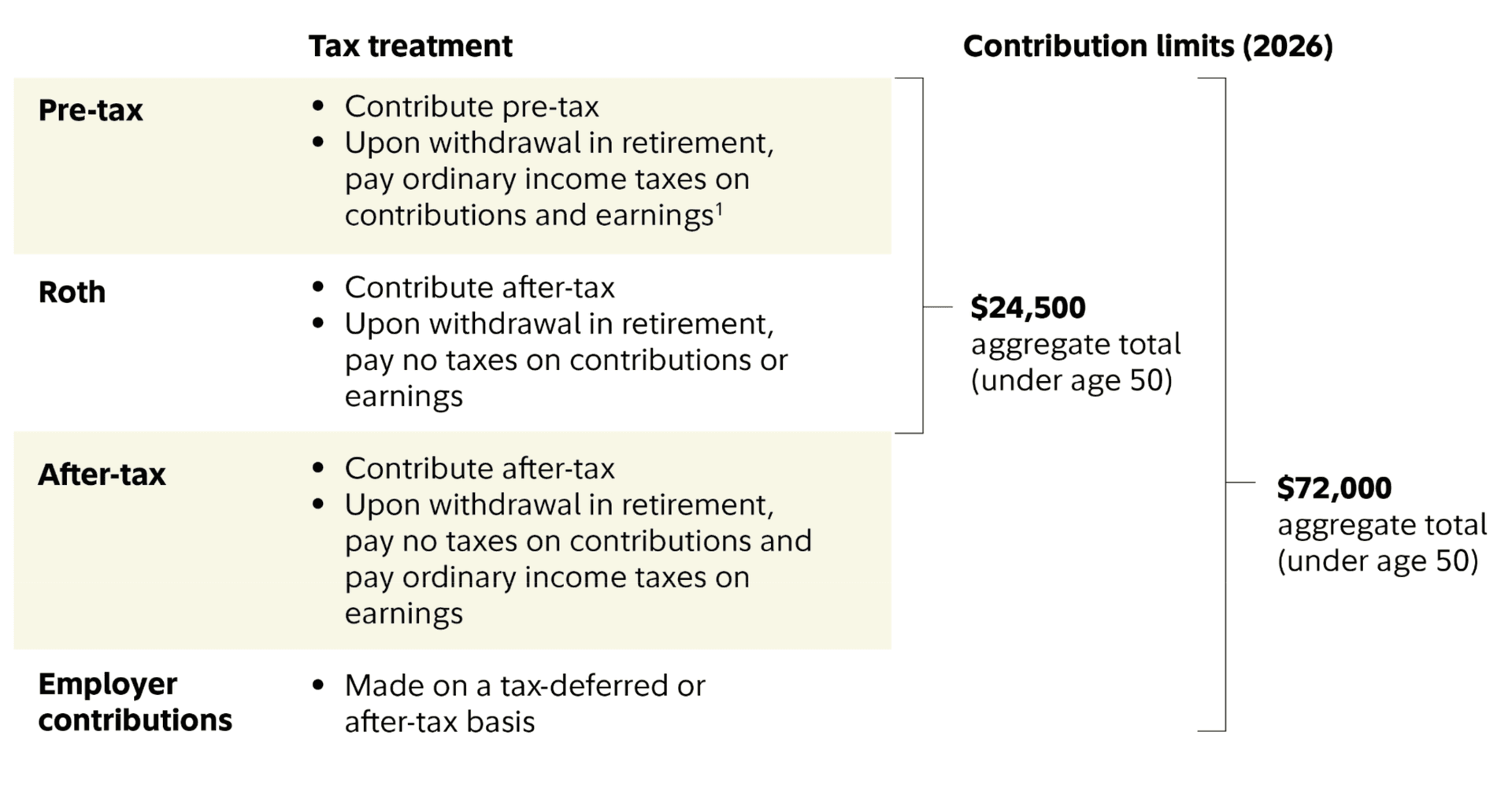
This is a strategy for individuals who have maxed out standard 401(k) contributions and want to save more. It involves making after-tax contributions to your workplace 401(k) and immediately converting those funds to a Roth 401(k). Eligibility depends entirely on your specific employer plan, which must explicitly permit after-tax contributions and either in-service distributions or in-plan conversions.
4.2 Rollover to Roth IRA (Optional)
Although these assets are initially generated and housed within your corporate Roth 401(k), the most effective strategy is to perform a tax-free rollover into a personal, self-managed Roth IRA upon your return to Canada.
While the Canada-U.S. Tax Treaty theoretically covers a Roth 401(k), maintaining funds within an employer-sponsored structure introduces significant administrative friction. Consolidating your assets into a single personal Roth IRA simplifies bookkeeping, making it significantly easier to draft the required cross-border treaty election letter and manage future withdrawals when you retire.
4.3 Recommendation
This is an advanced strategy for high-income earners. This strategy is only recommended if your specific employer plan allows for after-tax contributions. You must confirm that your brokerage supports automated "in-plan" conversions, which instantly move after-tax contributions into your Roth account to prevent any taxable earnings from accruing. There is no Canadian equivalent to this vehicle, making it an extra bonus for your retirement portfolio. Because these are after-tax contributions, this strategy is only recommended if there is still a significant surplus of income available after maximizing your other tax-advantaged retirement vehicles.
5. Health Savings Account (HSA)
5.1 The Truly Optimal Play
Instead of hoarding the HSA in cash to spend slowly in Canada, exploit the timeline lag allowed by the IRS. The IRS allows you to reimburse yourself for qualified medical expenses at any point in the future, as long as the expense occurred after the HSA was originally established.
- Track Everything Now: Save every single receipt for medical, dental, and vision care you incur while you are physically living in the US.
- Let it Grow: Keep the HSA fully invested in low-cost index funds to maximize compounding growth while you are working on your TN status.
- The Cash-Out Cleanse: Right before you cross the border back to Canada, add up all your historical US medical receipts and pull that exact dollar amount out of the HSA as a tax-free reimbursement. Note that you can use these funds in Canada once withdrawn. Also, note that employer matching for HSAs is available only through certain health insurance providers.
5.2 Recommendation
This is strongly recommended because it is triple-tax advantaged. When paired with potential employer matching and the flexibility regarding what the funds can be used for (via the reimbursement strategy), this is an excellent choice for your portfolio.
6. Retirement Playbook
This section will be expanded upon in a subsequent post. Further analysis is required for this scenario, as retirement will likely involve a combination of both US and Canadian accounts.